
How to Book a Flight & Everything You Need to Know About Airline Policies in 2026
October 24th, 2026

Booking a flight sounds simple until you're staring at six tabs, three fare classes, and a checkout page that suddenly adds $140 in "optional" extras. Add in the fact that airline rules changed a lot this year, and it's no wonder so many people feel overwhelmed before they've even picked a destination.
As someone who used to get completely overwhelmed booking plane tickets, I know that struggle. I always dreamed of being a seasoned flight veteran who knows all the tricks and hacks, and now I do!
I’m typically on anywhere from 45 - 60 flights annually, and if there’s one thing I’ve learned, it’s that the cheapest ticket is not always the cheapest trip. This guide walks you through booking a flight step by step, wherever you're flying from, and then breaks down what you actually get (and pay for) on United, Delta, and American Airlines in 2026. We'll finish with the travel hacks I use to keep flight costs down, because travel doesn’t have to break your wallet.
**Policies and fees change often. Always double-check the airline's own website before you click "purchase."

How to Book a Flight, Step by Step
To put it in simple terms:
1. Have your Real ID or Passport ready
- Have your Real ID or Passport ready
- Go to Google Flights and search for your destination and dates
- Select the flights that match best with your timeline (remember to look at connection times and layovers! You want at least a 1-hour layover for domestic airlines, and a 2-hour layover for international connections)
- Choose your fare type, then you will be rerouted from Google Flights to the airline's website
- Go through the booking process by entering your information, selecting your seats, etc.
- Enter your payment information, and book your flight!
- Remember, you can cancel any flights on all major U.S. airlines within 24 hours if things change
But if you really want all the information on why and how, here is a further in-depth look at each step:

1. Get your documents in order first
Before you search a single fare, check the paperwork. Nothing is worse than finding a great deal and realizing you can't use it.
- Passport: For international travel, many countries require your passport to be valid for at least six months past your travel dates. If yours is close to expiring, renew it before booking. You do not need a passport to travel on a domestic flight.
- REAL ID: For domestic flights within the U.S., you need a REAL ID-compliant license or another accepted form of ID, such as a passport.
- Name matching: The name on your ticket must match your ID exactly. A typo can mean fees or denied boarding.
2. Decide how flexible you are
Ask yourself three questions before you search:
- Can my dates move by a day or two?
- Can I fly out of a different nearby airport?
- Am I okay with a layover if it saves money?
The more flexible you are, the more you'll save! Changing your flights by a day can sometimes save you hundreds of dollars. If your dates are locked in (a wedding, a cruise departure, a tight vacation window), you'll pay more, and it's worth knowing that up front.
And here’s a little travel hack: ALL flights on major airlines can be canceled within 24 hours for a full refund. So if you see a flight deal, book it, ask for the time off the next day.
Before deciding on PTO, I always check flights first to see the cheapest flight dates, and then plan my time off around that. If you take your time off first, you’re going to be stuck paying whatever the prices are for those specific days.

3. Go to Google Flights
Google Flights is the best search engine tool for accurate pricing and comparison across all airlines. These show you prices across many airlines at once. Use the calendar or "flexible dates" view to see which days are cheapest, and set a price alert if you're not ready to buy yet.
Go to Google Flights, search your destination and dates, and start comparing prices.
4: Check the airline's own website
Once you find a flight you like, follow the booking process through Google Flights into the airline’s booking platform. The best way to book flights these days is to go directly through the Airline’s website. Booking direct is usually the better move because:
- If something goes wrong (a cancellation, a delay, a schedule change), the airline handles it directly instead of sending you back and forth with a third-party site.
- Changes, refunds, and seat selection are all easier to manage.
- You'll see the full fare options, including the ones that don't show up in search engines.
Sometimes an online travel agency is a few dollars cheaper. For most trips, that small savings isn't worth the headache if your plans change. I used to PREACH about third-party booking platforms 10-15 years ago, but times have changed, and booking direct is THE way, especially if you aren’t incredibly familiar with flying.
Here’s an example of why booking directly through the airline is better: If you miss a connection and booked through a third party, the airline can’t help. Instead, you’ll have to contact the booking platform, which can turn into hours of headaches and roundabout answers. If you miss a connection after booking with the airline, they’ll easily swap you and move you to the next available flight. It can save a lot of money, time, and stress.

5. Understand the fare class you're picking
This is where most people get tripped up. Almost every airline sells several versions of the same seat:
- Basic Economy: The cheapest fare, with the most restrictions (more on this below). Usually costs extra for seat assignments, carry-on bags, etc.
- Standard Economy / Main Cabin: Costs more, but usually includes a carry-on, easier changes, and better seat options.
- Premium Economy, Business, and First: Extra space, extra perks, extra price.
Before you pick, look at the "what's included" comparison. Check four things: carry-on bag, checked bag, seat selection, and whether you can change or cancel.
6. Do the real math
Here's the trick I use every time. Add up what you'll actually need:
- Base fare
- A checked bag each way (if you're not traveling carry-on only)
- Seat selection (if you care where you sit, or you're traveling with family)
- Any flexibility you want
Then compare that total against the next fare class up. A Basic Economy ticket that looks $50 cheaper can easily end up costing the same as a standard fare once you add a bag and a seat, and you'll still have the strictest rules attached.
7. Enter passenger details carefully
Type names exactly as they appear on your passport or ID. Add your frequent flyer number if you have one, and enter a phone number and email you actually check. This is where flight updates and gate changes will go.
8. Skip the add-ons you don't need
Checkout pages are designed to upsell you. Travel insurance, priority boarding, seat upgrades, and rental cars will all pop up. Take a breath, and only add what you've already decided you need. (You can usually add bags and seats later on the airline's app, often at the same price.)

9. Purchase Your Ticket (with CC when possible!)
Use a credit card instead of a debit card when you can. Credit cards offer stronger dispute protection if an airline cancels and doesn't refund you, and many travel cards offer trip delay coverage, baggage insurance, or free checked bags with certain airlines.
10. Use the 24-hour rule
In the U.S., if you book directly with an airline at least seven days before departure, you generally have 24 hours to cancel for a full refund. If you spot a better price right after booking, or realize you made a mistake, this is your safety net. Many airlines offer the 24-hour window even closer to departure, so check your airline's specific policy.
11. Save your confirmation and check in early
Screenshot your confirmation number and download the airline's app. Most airlines open online check-in 24 hours before departure. Check in as early as possible. On some fares, you'll get your seat assignment or a better boarding group by doing so.
Bonus: Know your rights
If an airline cancels your flight or makes a significant change to your schedule, you're generally entitled to a refund if you choose not to travel, rather than only a voucher. Keep your records, and don't accept a travel credit if what you actually want is your money back.

What is Basic Economy?
Every major U.S. airline now sells a "Basic Economy" fare, and they are not all the same. In general, Basic Economy means:
- You're in the last boarding group.
- Your seat is assigned at check-in or costs extra to choose.
- You usually can't change your ticket.
- Cancellation is limited (outside of the 24-hour window).
- You usually can't be upgraded, and you may not earn miles.
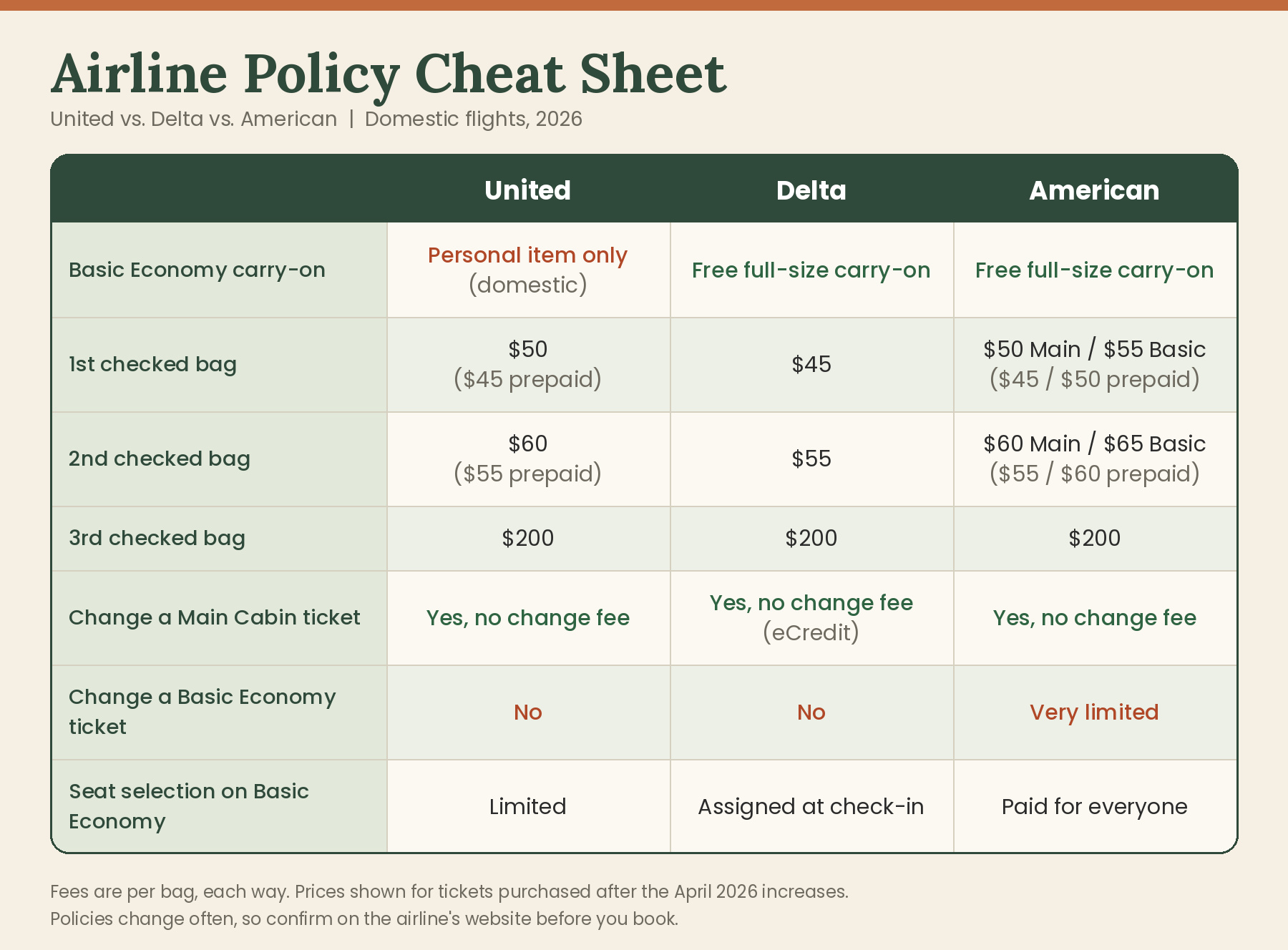
For a solo traveler on a short, flexible trip with a backpack, it can be a great deal. For families, anyone who needs a checked bag, or anyone whose plans might change, it's often a trap. Let's look at how the big three treat it.
Quick basics: economy and domestic baggage fees for major U.S. airlines:
Travel Hacks to Save Money on Flights
Booking smart can save you hundreds. These are the strategies I come back to again and again.
- Be flexible with your dates. Flying on a Tuesday, Wednesday, or Saturday is often cheaper than a Friday or Sunday. Use the calendar view on Google Flights to see the whole month at a glance.
- Set price alerts, then book when it drops. Track the route for a few weeks. When the price dips into a range you're happy with, buy.
- Book at the right time. As a general rule, domestic flights tend to be best priced about one to three months out, and international flights about two to eight months out. For peak travel (holidays, summer, spring break), book earlier. Fares have also been running higher this year because of fuel costs, so waiting for a miracle deal is riskier than usual.
- Check nearby airports. Flying out of or into a secondary airport can cut your fare significantly. Just make sure the ground transportation costs don't cancel out the savings.
- Try one-way tickets and mixing airlines. Sometimes two one-way tickets on different airlines beat a round trip. It's worth a quick comparison, especially if you're booking budget carriers.
- Pack light and beat the bag fees. With checked bags now running $45 to $55 each way, a carry-on-only trip on a round trip saves you $90 to $110 per person. A good personal-item backpack is one of the best travel investments you can make. Just check the carry-on rules for your fare class first.
- Prepay your bags. United and American both discount checked bags by $5 when you pay online ahead of time, and it avoids the higher airport price.
- Use an airline credit card strategically. If you fly one airline a few times a year, a co-branded card can pay for itself through a free checked bag alone. For a family of four, the savings add up fast. Just don't pay an annual fee for a card you won't use.
- Use points and miles. Even a small balance can cover part of a fare. Transferable points from travel credit cards can often be moved to airline partners for extra value.
- Consider shoulder season. Traveling just before or after peak season (think late spring or early fall for many destinations) means lower fares, fewer crowds, and better weather than you'd expect.
- Use the 24-hour rule as your backup. Book a fare that looks good, then keep watching prices for 24 hours. If something better pops up, cancel and rebook without penalty (when you're eligible).
- Watch for sales and error fares. Subscribe to a deal alert service or follow airline sale announcements. Airlines run flash sales a few times a year, and occasionally mistakes get published. If you see an incredible fare, move quickly.
- Don't pay for what you don't need. Skip the extra insurance if your credit card already covers it. Skip the seat fee if you don't mind where you sit. Skip priority boarding if you're traveling light.
- Read the fine print on Basic Economy. I'll say it one more time: always add up the real cost. If you need a bag, a seat, and any flexibility, a standard fare is often the better deal.


At any given moment, Shalee is either lost, hunting for ice cream, or obsessively planning her next adventure.
Born and raised in rural Michigan, she began exploring the shores of Great Lakes as a teen, often sleeping in her car to save money. Eventually, her urge to explore pushed beyond her Midwest borders. Today, Shalee shares her tips and stories to thousands of readers interested in adventure and outdoor tourism. Her pack now includes two spunky hiking cats and her partner, Josh. Learn more about her here.
Join the Adventure