
Everything to Know About Climbing Mount Fuji in Japan
December 26th, 2025

At the start of our most recent round-the-world trip, we stumbled upon tickets to Japan from the United States for 42,700 United Air Miles. We secured one-way tickets with only one big bucket list item for our visit: climb Mount Fuji.
Mt Fuji is one of the world's most famous and iconic mountains. Due to its proximity to Tokyo, one of the busiest cities in the world, it is also one of the most climbed mountains on Earth. Annually, over 200,000 people make the trek to the summit.
If you have an upcoming trip to the Fuji area and are interested in climbing to the top, you're in luck! It's a non-technical mountain that makes a fantastic and bucket-list-worthy day hike. The most challenging part about the mountain often lies in the logistics.
Here is everything you need to know about climbing Mount Fuji, how to get there, and different trail options to the summit:

Climbing Mount Fuji: Logistics
1. Flights
To begin, you must first book your airfare to Tokyo. We were unaware that there are actually two major hubs that service the city - Haneda and Narita.
We flew into Haneda, which is a bit smaller and much closer to the city. It is situated about 13 miles south of the city center, and can be easily reached by the monorail train line, along with buses and taxis if desired. The price via rail to Tokyo Central is about 500 to 700 yen ($3.50 to $4.75).
Our onward flight to Taiwan was through Narita, where we discovered that Tokyo has a second hub. This secondary airport is located about 48 miles east of the city center. The train lines still access it directly, but it is a bit more expensive at 1500 yen ($10.25). Luckily, we had an extra day and were able to book an Airbnb in a quiet suburb between Tokyo and Narita. Unless your flights are quite a bit cheaper or require fewer layovers, we recommend booking to Haneda wherever possible.
Also, make sure to double-check you head to the right airport for departure! Appartently going to the wrong airport and missing flights is a fairly common error.
2. Buses & Trains to Fuji
Tokyo Central Station offers quite a few transportation options, including buses and trains. If doing any of the three routes aside from the standard Yoshida approach, there are direct buses from Tokyo Central to Gotemba and Fujinomiya main stations. From here, you can catch buses that service the trailheads, more on that later.
Tokyo > Gotemba is about 1800 yen ($12.25)
Tokyo > Fujinomiya is about 3000 yen ($20.50)
If your goal is the standard Yoshida route, you will want to catch a train from Tokyo (or directly from the airports) to Shinjuku station, a bit west of the city center and close to the famous Shibuya scramble crossing. From here, the bus operates directly to Fuji Q highlands, or Kawaguchiko, for about 2200 yen ($15). You can also take trains to these destinations, but the route is somewhat complex with several changeovers. It is also more expensive than the bus so we recommend this option. They are fairly comfortable with wifi on board. Personally, we took the Shinjuku to Kawaguchiko bus both ways and it was fairly straightforward.
3. Mount Fuji Climbing Season
Climbing season for Mount Fuji is a little confusing. It breaks down into this:
A majority of hikers climb Mount Fuji during its open season dates, which begin early July and end in early September. The mountain can see as many as 5,000 climbers per day up the various routes. The climbing season shifts annually based on trail conditions and weather. Here is the official website for climbing Mount Fuji with trail reports, opening dates, and more.
People do climb outside of the open season, but it is highly discouraged due to the number of inexperienced climbers the mountain attracts. The government is cracking down on climbing outside of the typical season due to climbers requiring rescue & aid on the mountain who are ill-equipped. As of September 2025, it was still technically legal to climb outside of climbing seasons; however, this is the most recent flyer added to the official climbing website:
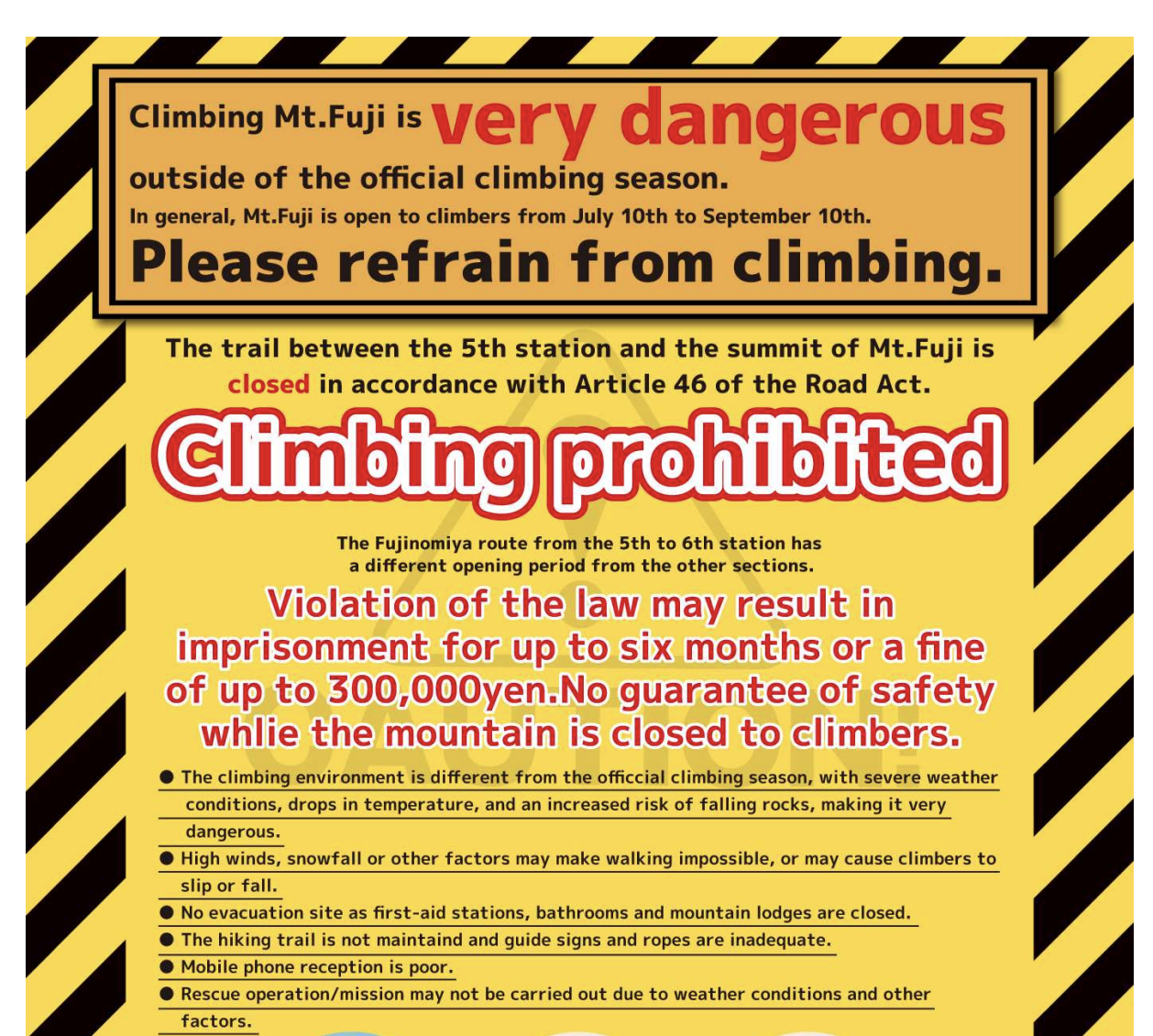
Photo from Official Mount Fuji Climbing
We encountered 6 hours of heavy rain, freezing temps, & hurricane force winds (hence the complete lack of actual photos from our climb!), so it's easy to see how those inexperienced in the mountains run into trouble up there. We're incredibly experienced in the mountains, and it was still one of our more brutal summits to date!
It seems the legality of climbing Fuji outside of the open season is now a grey area...so better off staying within season when planning your visit.
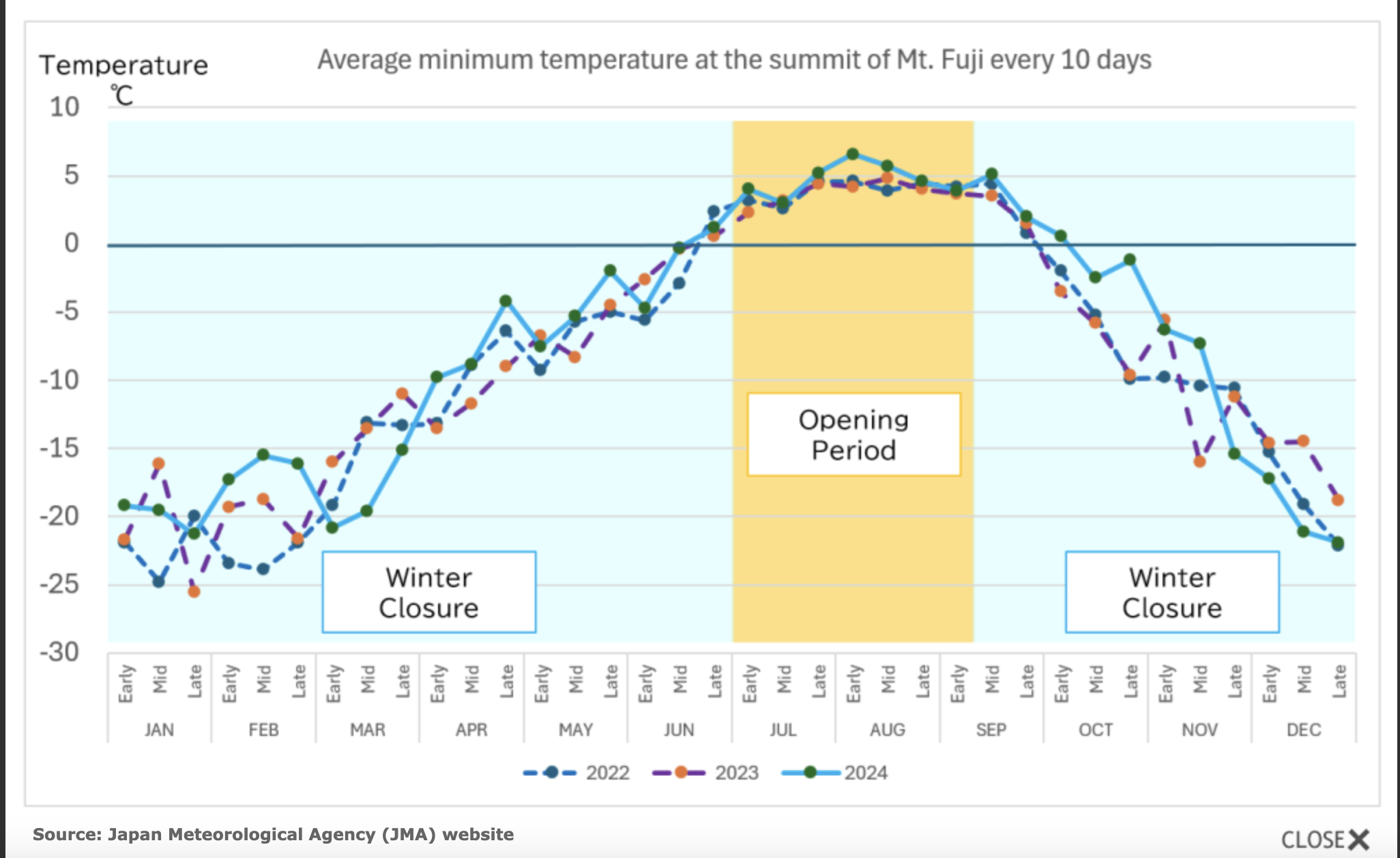
Photo from Official Mount Fuji Climbing Website
Climbing Mount Fuji: Routes
Now that you made it to one of the three city hubs that service the Fuji-san trailheads via bus, we will go into a brief summary of each route.
1. Yoshida (North) route.
This is the standard route up the mountain, beginning at the Subaru line 5th station.
Transportation - The bus operates from Fuji station with the next stop at Kawaguchiko. The round trip price is 3000 yen, and 1950 for a one way. This line operates on an expansive timetable from July 1st to September 10th with the first bus departing at 3am and the last bus leaving from the top at 6pm. The schedule constricts after the mountain is "closed" from September 11th to September 30th, then only a few buses each day from October 1st to full closure November 30th.
Features - The Yoshida trail is by far the most popular route on the mountain and more than half the climbers come from this way. Because of this, there are many amenities along the way, including huts, restaurants, shops, restrooms, and even coin showers. There is a separate descension trail. The trail starts around 7500ft, for about 5200 feet of total gain, and about 10.5 miles round trip. The official Fuji climb site estimates 7:15 for the climb, and 3:15 for the descent.
To learn more about this route, click here.

Photo from Official Mount Fuji Climbing Website
2. Fujinomiya (South) route.
This is the second most popular route up the mountain starting from the Fujinomiya trail 5th station.
Transportation - The bus operates from Fujinomiya central station, with some buses coming from Shin Fuji station first (which can be accessed via train by the Tokyo to Osaka line). The round trip price is 4000 yen, with 2750 for a one-way. The line operates from July 10th to September 10th, but the first bus doesn't depart until 6:35am, arrives at 7:55, and the last bus back from the top is at 6:30pm. Still more than doable as a daytrip, but a bit more tight.
Features - This route has the least amount of elevation gain and the shortest mileage, making it attractive for a quicker ascent. There is no separate descent trail, so it can get quite congested at many spots. The trail begins around 7800ft, for about 4600 feet of total gain, and about 6.2 miles round trip. With this route, you don't have to go all the way around the rim to access the true summit (Kengamine), but you may choose to for a bit of an additional walk. The official fuji climb site estimates 5:10 for the climb, and 2:40 for the descent.
To learn more about this route, click here.
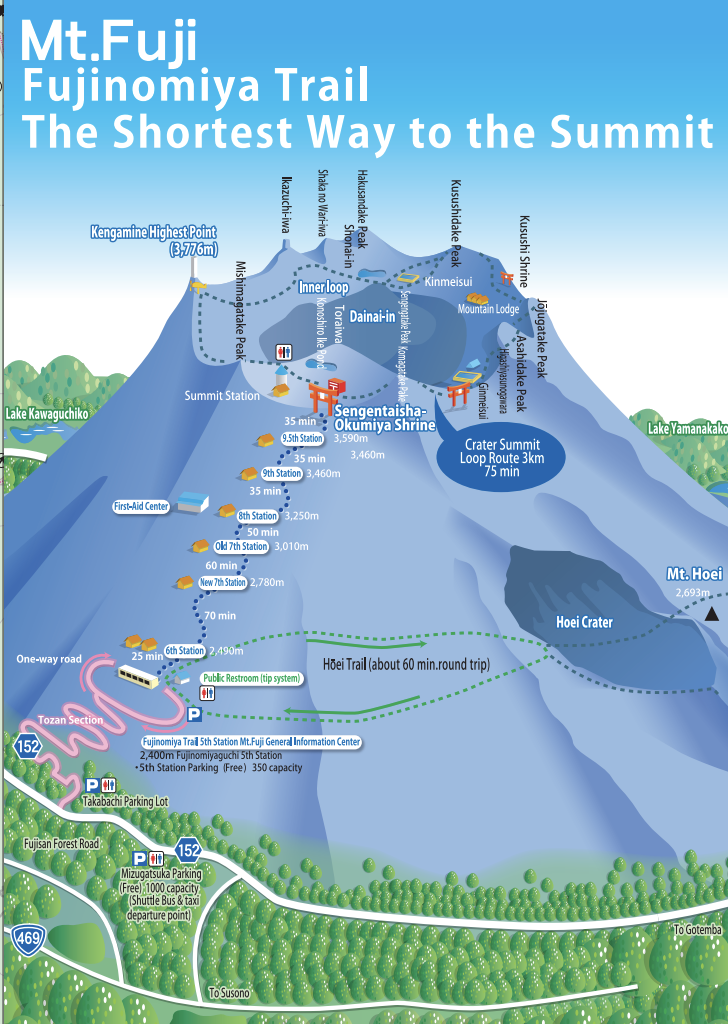
Photo from Official Mount Fuji Climbing Website
3. Subashiri (East) route.
A less-popular but aesthethic alternative route starting from the (you guessed it) Subashiri 5th station.
Transportation - The bus operates from Gotemba station, with a round trip price of 2500 yen, and a one-way costs 1800 yen. The line operates from July 10th to September 10th. The first bus doesn't leave until 6:45am, arriving at 7:45, and the last bus leaves from the trailhead at 6pm (7pm on weekends and holidays). Could be doable as a daytrip bullet climb depending on pace.
Features - This route has been called the "easiest way up Mt Fuji". This is probably due to the accomodating grade, increased tree cover on the lower third, and soft scree plunge stepping on the separate descent line. In addition, this is a great route for viewing Fuji-san's iconic casted shadow around sunrise. The trailhead is situated around 6500ft, for about 6000 feet of total gain, and about 11 miles round trip. The official fuji climb site estimates 6:25 for the climb, and 3:20 for the descent.
To learn more about this route, click here.

Photo from Official Mount Fuji Climbing Website
4. Gotemba (southeast) route.
A seldomly visited, long and scenic trail up the mountain. It begins from the Gotembra trail 5th station.
Transportation - This bus also operates from Gotemba station in town, with a round trip price of 2300 yen, and a one-way ticket costing 1280 yen. The line operates from July 10th to September 10th, with the first bus departing at 7:35am arriving at 8:05, and the last run back from the trailhead leaves at 5:10pm. It would be fairly difficult to squeeze this one in as a bullet climb day trip, but may be possible with a subashiri descent itinerary. This is the only other trailhead with buses running outside the summer season where the mountain is "open", but would not be feasible for a day hike.
Features - This is the longest route up the mountain, aside from the Yoshida trail if you started from the shrine near the bottom. If it is an especially busy weekend and you are feeling motivated, this one would be ideal for the relative solitude. The trailhead elevation is around 4800ft, the cumulative total gain is around 7700 feet, and it is 12 miles round trip. The official fuji climb site estimates 8:40 for the climb, and 3:30 for the descent.
To learn more about this route, click here.

Photo from Official Mount Fuji Website
Car Access to Trailheads
All of the above trailheads can generally be accessed by car outside of the "open" summer climbing season from July 10th to September 10th. The entire mountain will be closed from November 30th to April 30th, but as long as conditions allow, the trailheads will be accessible for private vehicles from May 1st to June 30th, and September 10th to November 30th. Aside from the Yoshida trail bus routes, we recommend a rental car or taxi transport to the other 3 routes if climbing in the "offseason".

Our Experience Climbing Mount Fuji
For our own personal climb, the journey began by taking the bus from Shinjuku to Kawaguchiko and staying in a hostel nearby. If you are into roller coasters and amusement parks, there is also a stop at the nearby Fuji-Q Highlands. Fun fact: this used to have the tallest roller coaster in the world!
The first bus departed from Kawaguchiko at 9:40. We had attempted to use some nearby coin lockers to store our luggage while on the mountain, and wasted nearly 2500 yen between a faulty locker and a misunderstanding of how they operated. Be sure to place all of your objects inside, insert the coins, then turn the key fully to the left before extracting. If you don't complete all of these steps in precise fashion and order, you lose your money. Consider alternative storage means, whether through manned drop-offs, or with your accommodation.
We arrived at the trailhead (Subaru 5th Line station) just past 10:30. This would give us just under 7:45 to make it up to the top, and back down before the last bus departed back down the mountain at 18:15.
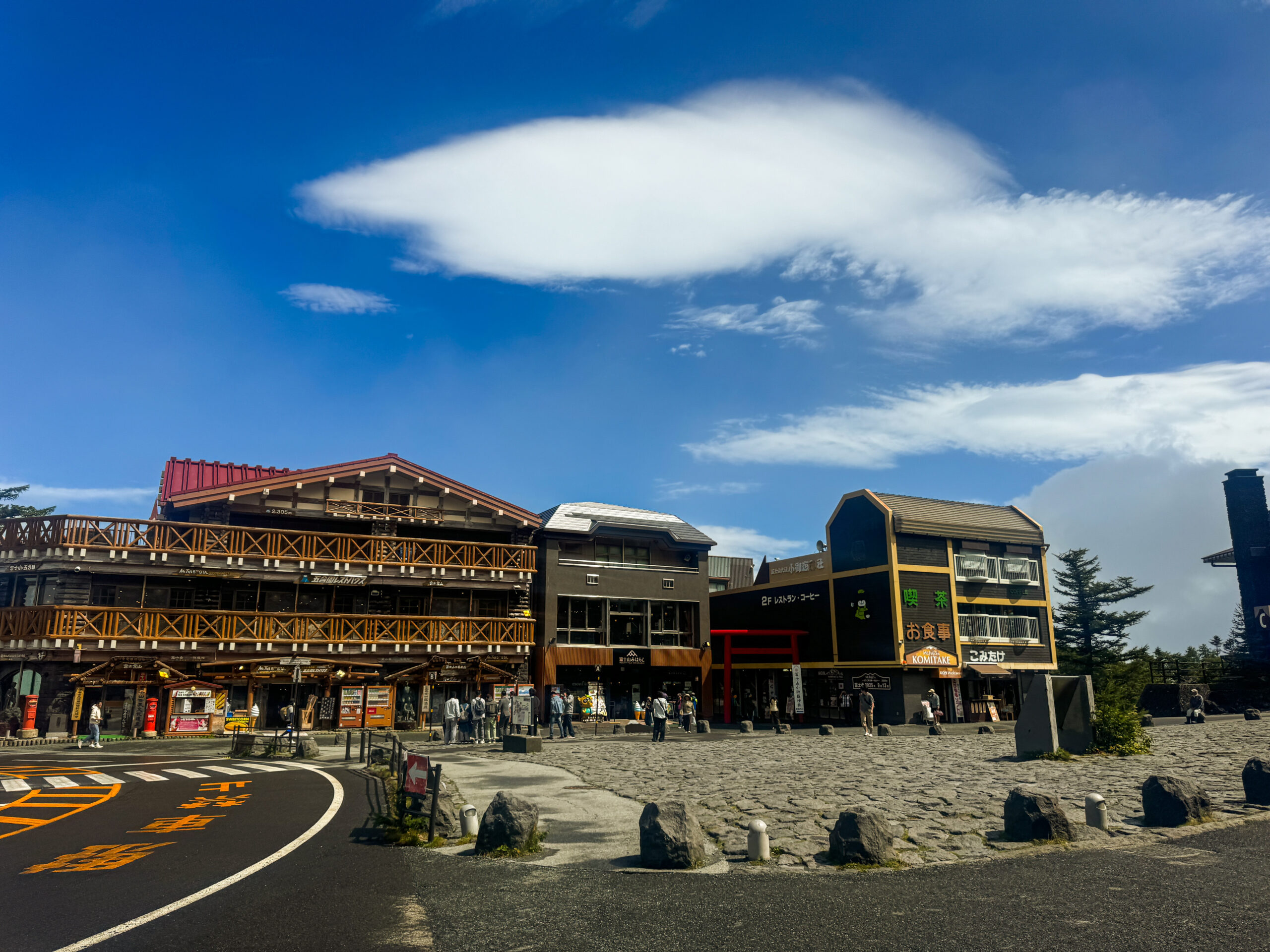
Despite the thick cloud cover below and above our elevation, conditions were dry as we hiked along the road until the turnoff for the trail leading up the mountain. Since we were just a few days past "open season" ending on September 10th. There are two barriers highly discouraging use of the trail. Despite the dissuasion tactics of the local officials, it is not illegal to climb in the offseason. After skirting by these barriers, we soon came across many workers decommisioning and winterizing the many huts and stations along the way, in addition to a handful of locals and international visitors also hiking the Yoshida trail.
After many wide, and well-graded switchbacks, the trail transitioned to a more narrow, steep, and rocky profile. Poles for balance would be very useful as you watch your step carefully. Many buildings and stations are passed in this section, all in the process of being boarded up. In the normal season, there would be many shops, huts, restaurants, and other services more likened to that of a town market than a mountain trail. The weather deteriorated rapidly in the upper third of the climb, as the temperature dropped, wind strengthened, and rain amplified. There are many signs along the trail to be sure you don't somehow get lost, and the latest ones promised we were close as we shuffled up, soaked to the bone. Finally making it to the gates of the Shrine to the east summit of the rim, Kusushi.
Despite the horrid weather similar to our experience on Mauna Kea, and only tens of meters of visibility, we pressed on counter clockwise around the rim. Surprisingly finding some shelter from the wind on the way to the tallest point on Fuji, the west summit, Kegamine.
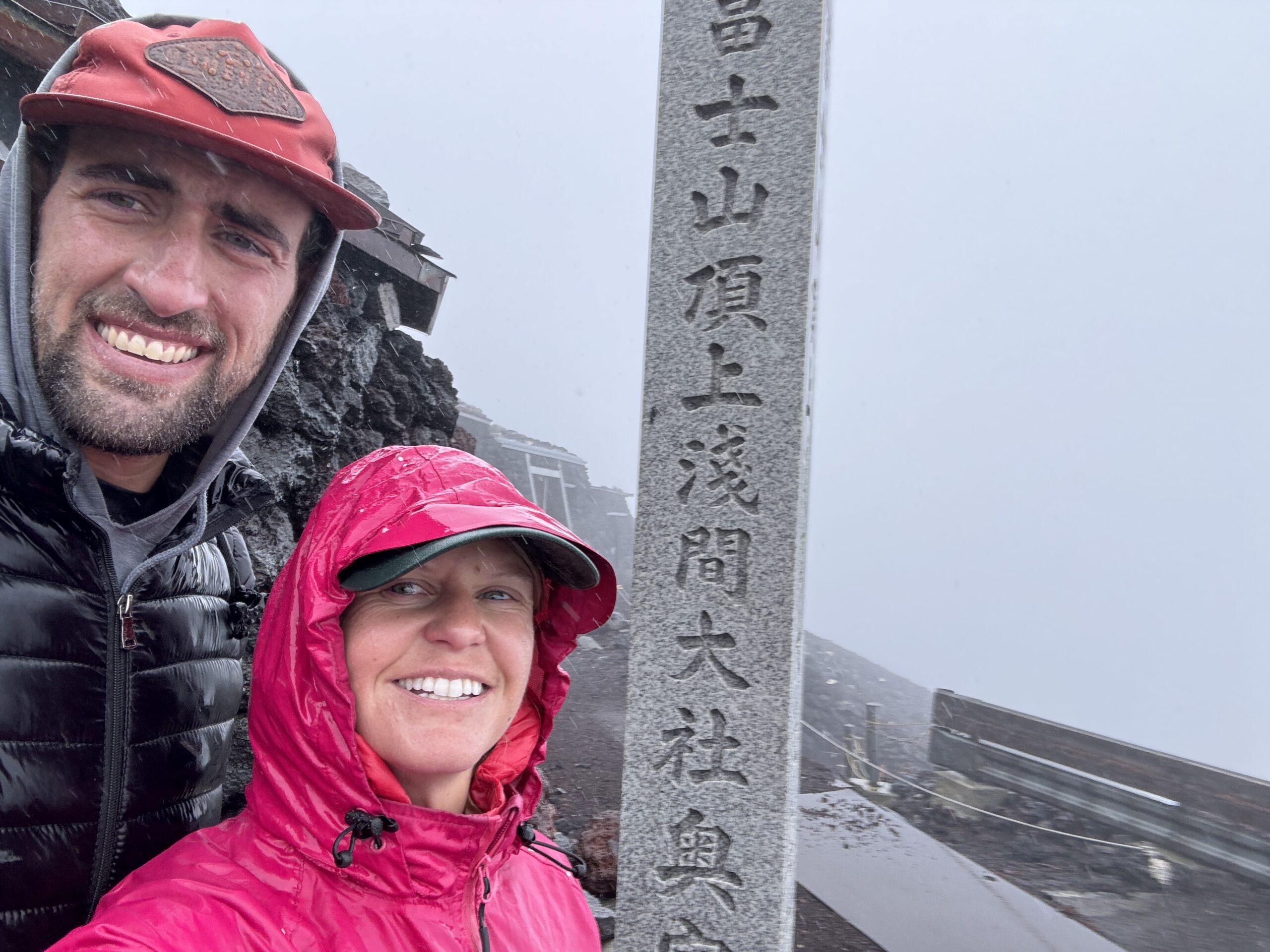
Miserable at the summit marker
The rest of the summit rim circumnavigation was a tough battle, with incredible sustained winds and gusts that made it hard to maintain an upright position, let alone a course that followed the path. In the end, we barely made it around without getting blown off the mountain. This time of year, the soft Subashiri descent route is closed for construction access so we were forced to descend the uphill route. This was a bit painstaking through the steep rock sections as the knobby volcanic alleys were now drenched and slippery.
Eventually, we thawed out as we dropped elevation, but the rain did not let up in the slightest. A classic misery fest, butit motivated us to get down as fast as we safely could. In the end, we arrived back at the trailhead just after 4:30, making for a near 6-hour round-trip outing. We took shelter at one of the many trailhead complexes with shops and restaurants before catching the 5:15 bus back to Kawaguchiko.
If you do decide to opt for an offseason "bullet" climb of Fuji-san, we recommend downloading a GPS track on mountain fitness apps such as Peakbagger, or Strava. So you can check pacing as you make progress to determine if you will be able to make the last bus back down the mountain.
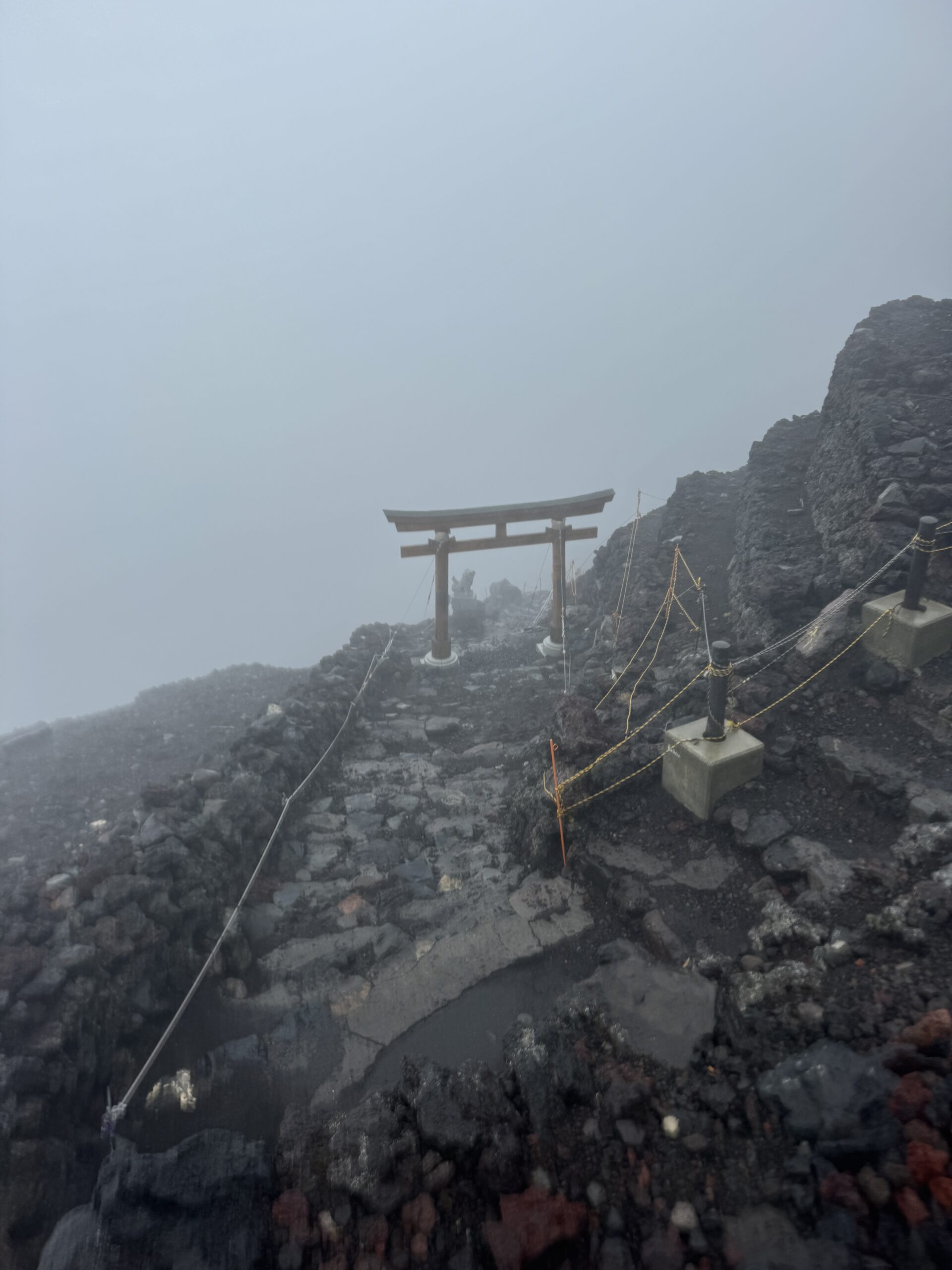
The only photo I took of the summit entrance
Additional Things to Know About Japan
1. Don't fold your money - Japan is extremely picky about the condition of accepted currency. As Americans, it is quite common for us to fold bills within our wallets. Money that is not smooth or in great condition will not be accepted by a majority of vendors
2. Removing shoes before entering houses, onsens, or guesthouses is common and expected throughout the country.
3. Japanese hotel rooms are famously small compared to hotels in the United States. But the fancy toilets make up for the lack of room!

At any given moment, Shalee is either lost, hunting for ice cream, or obsessively planning her next adventure.
Born and raised in rural Michigan, she began exploring the shores of Great Lakes as a teen, often sleeping in her car to save money. Eventually, her urge to explore pushed beyond her Midwest borders. Today, Shalee shares her tips and stories to thousands of readers interested in adventure and outdoor tourism. Her pack now includes two spunky hiking cats and her partner, Josh. Learn more about her here.
Join the Adventure